
Double Elimination Bracket Generator
Type in your players or teams in seed order and get a complete double elimination bracket — winners bracket, losers bracket and grand final — with byes placed automatically. Click a name to record a win and the bracket fills itself in.
- Free to use
- No sign-up
- Runs in your browser
Build a double elimination bracket
Tournament Organiser Printable Pack
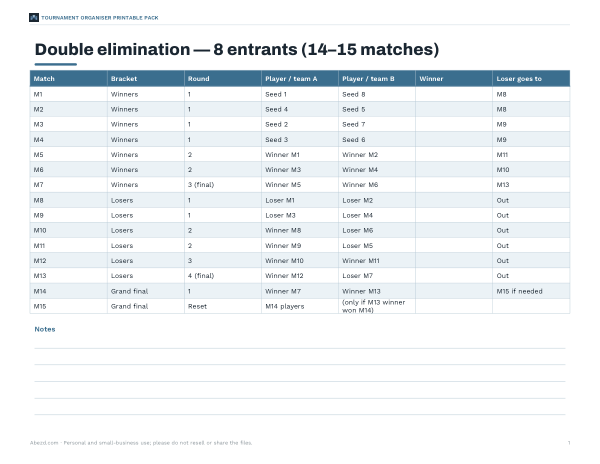
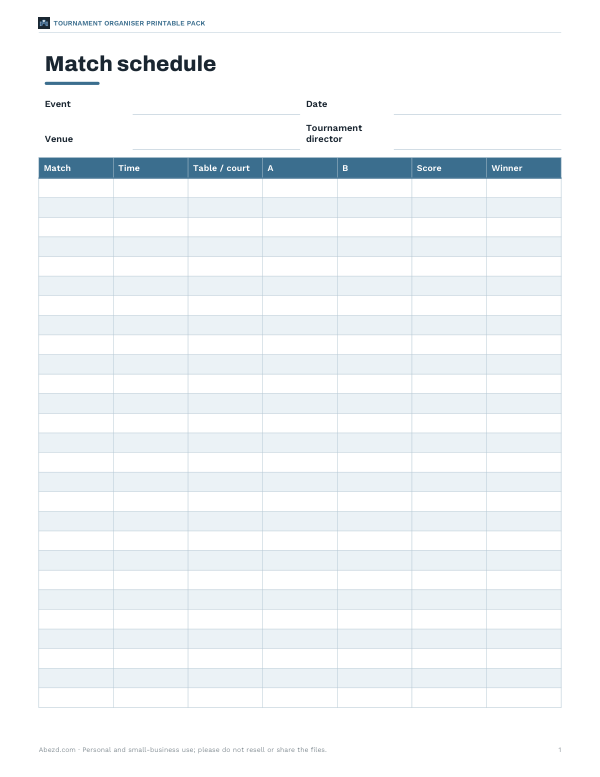
Printable blank double elimination match sheets, a match schedule and scorecards for running the event.
- 8-entrant double elimination match sheet (PDF, DOCX, XLSX)
- Match schedule & scorecards (PDF, DOCX, XLSX)
Formats: PDF, DOCX, XLSX. Instant download after payment (link valid 72 hours, up to 5 downloads). AI-assisted: the templates were drafted with AI help and reviewed and laid out before publishing.
$5.00 USD, one-time
- Instant download
- 7-day refund
- Secure checkout by Stripe
7-day money-back guarantee. Full refund within 7 days of purchase, even after you download.
Full refund within 7 days — see the refund policy and license.
Free printables
Single sheets you can print right now, no sign-up. The full pack adds every sheet in one download plus the editable files.
How a double elimination bracket works
In double elimination, a player or team is only knocked out after losing twice. Everyone starts in the winners bracket. Lose once and you drop into the losers bracket (also called the consolation or elimination bracket), where you keep playing until a second loss. The winner of the winners bracket meets the winner of the losers bracket in the grand final.
Because the winners-bracket champion has not lost yet, many events use a bracket reset: if the losers-bracket player wins the first grand final, both now have one loss and a second, deciding match is played. Choose “Single grand final match” if you do not have time for a possible extra match.
Using the generator
- List entrants one per line, strongest seed first. If you have no rankings, choose “Random draw”.
- Choose standard seeding (1 plays the lowest seed, 2 the second lowest, and so on) or keep your own order.
- Click Generate. Byes are added automatically so the bracket size is a power of two (4, 8, 16 or 32).
- After each match, click the winner's name. The winner advances and the loser moves to the correct place in the losers bracket.
- Clicked the wrong name? Click the other name; later results that depended on that match are cleared.
- Print the bracket for a wall chart, or keep the page open at the scorer's table.
Byes and bracket size
A bracket has to double at every round, so it needs 4, 8, 16 or 32 slots. With 6 entrants you need an 8-slot bracket and 2 byes; with 11 entrants, a 16-slot bracket and 5 byes. With standard seeding, byes go to the top seeds, which is the usual reward for ranking highest. A player with a bye advances without playing, and the empty “loser” slot in the losers bracket also becomes a bye, so no one waits for a match that will never happen.
| Entrants | Bracket size | Byes | Matches (without reset) | Matches (with reset) |
|---|---|---|---|---|
| 4 | 4 | 0 | 6 | 7 |
| 6 | 8 | 2 | 10 | 11 |
| 8 | 8 | 0 | 14 | 15 |
| 12 | 16 | 4 | 22 | 23 |
| 16 | 16 | 0 | 30 | 31 |
| 24 | 32 | 8 | 46 | 47 |
| 32 | 32 | 0 | 62 | 63 |
For n entrants a double elimination event plays 2n − 2 matches, or 2n − 1 when the grand final goes to a reset. That is roughly twice a single elimination bracket, so plan time accordingly.
How the losers bracket is structured
The losers bracket alternates between two kinds of rounds. In a “minor” round, players already in the losers bracket play each other. In a “major” round, those winners meet the players who have just dropped down from the next winners-bracket round. With 8 entrants, winners round 1 produces four losers who play two losers-bracket matches; the two survivors meet the two losers of winners round 2; and so on, until the last survivor meets the loser of the winners final. The generator reverses the order of drop-downs on alternate rounds, a common method to reduce immediate rematches between players who have just met.
Scheduling tips
- Number every match (the generator shows M1, M2…) so players know which table or court to go to.
- Losers-bracket matches can often start while the winners bracket is still playing — watch for matches whose two slots are filled.
- Allow short breaks for players who have just played; in the losers bracket some players play several matches in a row.
- Decide in advance whether the grand final uses a reset and whether it is best-of-one or best-of-three.
- For side choice, colours or first serve, the higher seed or the winners-bracket player usually gets the choice.
Worked example: six teams
Hawks, Tigers, Wolves, Eagles, Sharks and Bears are seeded 1 to 6 in an 8-slot bracket. Seeds 1 and 2 (Hawks and Tigers) receive byes, so the first round has two real matches: Wolves v Sharks (3 v 6) and Eagles v Bears (4 v 5). The two first-round losers meet each other in losers round 1 only if both exist; the byes mean one losers-bracket slot is empty, so a player advances automatically. The total number of matches is 2 × 6 − 2 = 10, or 11 if the grand final is reset.
Double elimination versus other formats
| Format | Knocked out after | Matches for n entrants | Best for |
|---|---|---|---|
| Single elimination | 1 loss | n − 1 | Short events, large fields |
| Double elimination | 2 losses | 2n − 2 (or 2n − 1) | Fairer results when one bad match should not end the day |
| Round robin | Nobody | n(n − 1) ÷ 2 | Small groups, leagues |
| Swiss system | Nobody | Rounds × n ÷ 2 | Chess, card games, big fields |
Common sports and games that use double elimination
Double elimination is popular for cornhole, darts, pool and billiards, table tennis clubs, softball and baseball tournaments, wrestling consolation brackets, esports and fighting-game events. It gives every entrant at least two matches, which matters when people have travelled or paid an entry fee, and it lowers the chance that a strong team goes out early because of one unlucky game.
Frequently asked questions
How many games are in a double elimination tournament?
For n entrants, 2n − 2 matches, or 2n − 1 if the grand final needs a reset match.
What is a bracket reset?
If the losers-bracket champion beats the winners-bracket champion in the grand final, both have one loss, so a second final decides the title.
Who gets byes?
With standard seeding the top seeds get byes. The number of byes is the bracket size minus the number of entrants.
Can I edit a result?
Yes. Click the other name in the match; later matches that depended on it are cleared so you can re-enter them.
Does the bracket save automatically?
No. It lives in this page only. Print it or keep the tab open during the event.